
To Know God
But can we really?

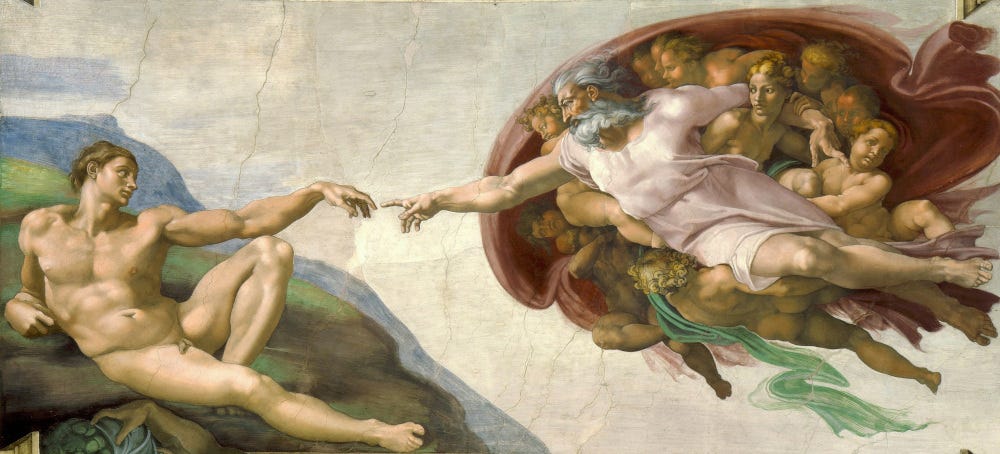
In a recent conversation with a close friend — someone I’ve always considered spiritually inclined — I heard him say something that surprised me. He told me that he didn’t have the kind of faith in God that I do. When I asked why, he explained that he struggles to believe in a God as a man in the sky, passing judgment on humanity.
My immediate reaction was: Wow!
How could someone who openly rejects modern organized Christianity and lives a somewhat spiritually oriented life still hold such a simplistic conception of God: anthropomorphic, patriarchal, and authoritarian?
I recall attending Catholic school as a boy, forming a similar view, which fixed my ideology in such a way that, for the next two decades, I resisted the use of the word God in reference to what’s out there. I resisted other words too, like church, worship, sin, and Jesus.
It was at the point where I witnessed the violence of the nuns toward the children, and eventually toward me, that I didn’t feel Christianity had anything for me. And then some Pentecostal neighbors of ours, who probably thought I was young and impressionable such that I could possibly be saved from a life of sin, petitioned my mother and stepfather to take me to one of their services. They asked me and I said, “sure.” I was game for exploration without obligation.
Two and a half hours into the service with abundant wailing and praying in tongues, I thought, this isn’t for me. Maybe if they had tried to explain some of what was occurring, I might have gained some sense of the point of it.
And yet, I always felt a presence. It just seemed to make sense to me that there was something behind the lives we live. Many years later when I was introduced to the world of Native American ceremony, I felt a great resonance with the practice, while scratching my head at the subtle influence of Christianity.
Some four years into my journey with the ceremonies, I met the man who became my primary teacher in the ways, a Navajo medicine person who, one year later, adopted me as his brother and took me into his family. Following were many years of travel together, attending ceremonies around the country and continual teaching in the traditional ways without any hint of Christian influence.
In this realm, the word God was commonplace. Many times, it was “Creator.” Sometimes it was “Diyin,” the Navajo word for God. And so, it took me a few years to get past my aversion to the word. What helped was a growing relationship with the ineffable, and a sense that God was much more magnificent than what I had been led to believe as a child.
And still many years later, as I was studying various philosophies, I learned about non-duality, which is when the notion of God as a substrate of all existence made the most sense to me. This doesn’t mean God is a thing, but rather an energy and a force that underlies everything everywhere.
And when discussing the nature of God, we must acknowledge the severe limitation of language. If God is the creator of the Universe, it stands to reason that God’s intelligence is not just off the charts, but wholly incomprehensible to those of us experiencing this third-dimensional realm known as human life. So, when I say things like God being an “energy” and a “force,” those words are puny and inadequate.
Which also means there are not likely to be any words in human language capable of explaining the true nature of God. Which also leads us to an important question: Is it even possible to truly know God?
I believe the answer is yes, but not so much by learning the definition of a collection of words and phrases, but by transcending the words to a deep abiding feeling of the presence that is always there.
And we can only have that by having transcendent spiritual experiences — experiences so powerful they are beyond words. Moments where time stops. Where, in the briefest instant, everything is right with the world and there is beauty all around us.
I can imagine that a woman giving birth is a transcendent experience. But graduating high school or college is not. It may feel inspiring or joy-filled, but the ceremony itself is still rooted in our notions of accomplishment, which is egoic in nature.
There are many stories of people coming together in heroic ways following significant natural disasters. They are moments where the intensity of the situation gets us out of our heads and fully into our hearts, when all we want to do is help people, especially strangers.
There are abundant stories of soldiers doing incredibly heroic things in battle. It’s not that war, and the death and destruction it brings, is good for humanity, but for the soldiers on the field who, in the intensity of battle, have only each other to rely on for their very survival, it can be transcendent. In such an environment, the bonds they form are among the most intense we may ever feel toward other human beings.
I’ve been fortunate enough to experience many, even countless, transcendent moments. Mostly in the ceremonies, but not only there. I’ve seen many things that would be considered unexplainable by conventional science. I’ve experienced miracles many times over such that for me the presence that is always there is real and palpable.
It’s not hard for me to acknowledge the presence of God in my life — but can I put it into words?
Not likely.
I can only talk around it. I can present shades and tones that reflect the footprint of God without being able to say, “See, there is God. He/she/it looks exactly like this.” Even applying a pronoun of any kind is a lessening of what God is.
The Navajo are fond of the use of the word “Nizhóní,” their word for beauty or beautiful. In my experience, they are referring to the footprint of God by constantly affirming the beauty all around us, in us, through us, above and below, and, by extension, they are expressing the feeling tone associated with their connection to God.
Not only have I never heard a Navajo, or any Native person, refer to God as authoritative and patriarchal, in my reading of the quotes from Jesus I’ve never interpreted Jesus as referring to an authoritative, patriarchal God. The Bible uses he and him pronouns, but wouldn’t that be a mere limitation of human language? And how much has been lost in translation from the original Aramaic that Jesus and his disciples spoke as their common language? From Aramaic to Greek, from Greek to Latin, and from Latin to English.
Then, in a conversation with another friend, reflecting on this very question, when I was lamenting how I feel Christianity has done a great disservice to humanity by oversimplifying God, he said, “No, it’s not that. It’s art.”
Art?
I was stumped, until he explained that it’s been the artists, throughout the ages, attempting to depict God in human form who have influenced our perception of the nature of God.
“Of course!” I thought.
We have so exalted the works of Michelangelo, da Vinci, and others that we have elevated their works to the level of divinely inspired. Their works are extraordinary indeed, perhaps even transcendent, but still puny as true representations of God.
The same can be said of the most gifted and inspired poets, philosophers, novelists, preachers, priests, and ministers. Are they truly describing God or merely hinting at God? Or worse, are they infusing their image of God with their own egoic need for authority and self-aggrandizement?
No matter how I may attempt to describe God, there is still going to be some of my personal influence, language limitations, and egoic threads — large or small. We can only strive to get closer to an understanding without ever nailing it with precision.
We can no more articulate God than we can fully express our deepest essence to another human being. That is because, if God is a substrate, an energy and an intelligence that is always present, then that means God is in all things, including us.
And if God is a substrate, then there is no separation between us — that all things are inherently connected. Which, by the way, has been proven through the study and experimentation of quantum mechanics.
And so… given all limitations mentioned herein, here is my grossly imperfect expression of the nature of God:
An intelligence beyond comprehension that is expressing, being, allowing, and loving —existing in all things, all beings, all life. It is life, and life is it.
But then the use of the word “loving” in my definition is ambiguous, because we can’t even truly define love. Webster defines it as, “an intense feeling of deep affection; a feeling of deep romantic or sexual attachment to someone,” and so on.
And yet, psychologists have recognized that it can be considered a loving act to let one’s children or teenagers suffer the consequences of their own ill-informed decisions. We call it “tough love.” That letting them suffer helps them grow and mature. That we love them that much to watch them suffer, knowing it will make them stronger.
In twelve-step recovery circles, it’s understood that enabling an alcoholic or addict in their addiction is not helping them, while the concept of “detachment with love” is discussed in depth — letting the addict suffer the consequences of their addiction hoping that one day they will hit their rock bottom and become willing to do what is necessary to become sober and piece their lives back together again.
The part of Webster’s definition, “deep romantic or sexual attachment,” is not, what I believe, the true nature of love, but more a self-centered need for another person to validate our worth.
I could go on about just this one word, while the point is that even to clearly define one word in my definition, “loving,” is nearly impossible. And yet, many mystics and spiritual teachers have described God as a substrate (my word, not theirs), with the substrate being love.
And so, here we are at the quandary: How do we define God in a way that comes within a ballpark understanding of God’s true nature?
The answer is, we can’t.
So, as a stand-in for the true nature of God, artists have depicted God in human form, always male, always with a gray beard, reflecting cultural assumptions and limiting beliefs about what the Universe is, what God is, and why we are here experiencing life in human form. All of which (by the way) contradict the teachings of the greatest of our spiritual teachers and the findings of quantum mechanics.
Given such an understanding, why must we continue to limit our thinking and our ability to connect in a visceral way with the God of our understanding by characterizing God in anthropomorphic terms?
And one last thought to share: The anthropomorphic image of God is widely explained by the biblical passage from Genesis, “God created man in his image.”
The problem with this interpretation is that we assume we are our bodies — bipedal, humanoid, binary, physical beings with lots of brain capacity.
Really?
Do we really think God is humanoid? And more to the point, do we really think we are nothing more than our bodies? What if that passage was intended to convey that we are of a divine nature, such as God? “As above, so below.” That we are energy, as the quantum physicists have shown. That we have eternal souls, such as God. And that we take such attributes directly from the image of God.
Thus, to know God, is to know ourselves. Which is how we grow closer to a true understanding of God. One small step at a time.